
Why Choose Dr. Rohan Patel for Urethral Stricture Treatment in Ahmedabad?
Expert Reconstructive Urologist



Comprehensive Advanced Urethroplasty Surgery by Dr. Rohan Patel
A urethral stricture is a narrowing of the urethra caused by scar tissue formation. Although it may initially appear as a minor urinary problem, untreated urethral stricture disease can significantly impact quality of life and may eventually lead to urinary retention, recurrent urinary tract infections, bladder damage, stone formation, and even kidney dysfunction.
Dr. Rohan Patel is recognized as the best urologist for urethral stricture treatment in Ahmedabad, provinding comprehensive and state of the art evaluation, diagnosis, minimally invasive procedures, and advanced reconstructive urethral surgery for simple and complex strictures.
Many patients spend years undergoing repeated urethral dilatations, catheterizations, or internal urethrotomy procedures without understanding why the problem keeps returning. While these treatments may temporarily improve urine flow, they often fail to address the underlying scar tissue responsible for the obstruction.
Modern reconstructive urology has transformed the treatment of urethral stricture disease. Today, advanced urethroplasty techniques can provide long-term, durable outcomes for many patients, even in complex and recurrent cases.
Whether you have recently been diagnosed, have undergone multiple failed procedures, or are seeking a second opinion regarding reconstructive surgery, an accurate diagnosis and individualized treatment plan are essential to achieving the best outcome.
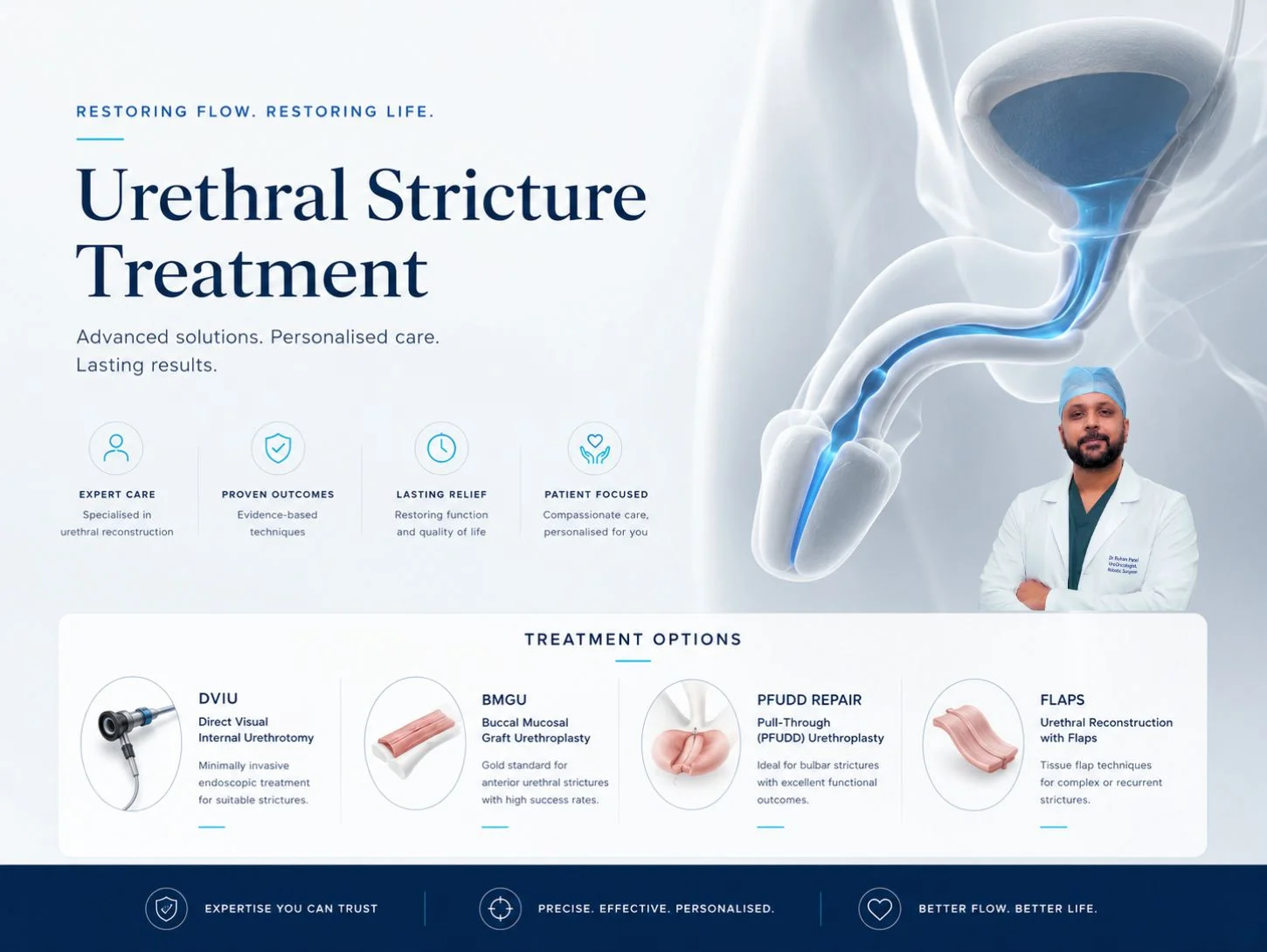
Successful treatment begins with understanding that not all urethral strictures are the same. The location, length, severity, cause, and previous treatment history all influence the most appropriate management strategy.
Our treatment approach focuses on identifying the underlying problem and recommending the most effective solution rather than repeatedly providing temporary symptom relief.
Detailed evaluation and review of symptoms.
RGU, MCU, uroflowmetry, and investigations.
Discussion of options and expected outcomes.
Procedure tailored to your anatomy.
Careful postoperative management.
Monitoring healing and long-term results.
The urethra is the tube that carries urine from the bladder to the outside of the body. When scar tissue develops within or around the urethra, the passage narrows and restricts urine flow. This condition is known as urethral stricture disease.
The narrowing may develop gradually over months or years. Some patients initially notice only mild urinary symptoms, while others present with severe obstruction. Without treatment, the condition may progressively worsen.
Urethral Stricture symptoms vary depending on the severity of narrowing as well as duration of the disease. Common symptoms include:
Some patients also experience bladder stones, recurrent prostatitis, or kidney-related complications due to longstanding obstruction.
Understanding the cause of the stricture helps determine the most appropriate treatment strategy. Common causes include:
This is one of the most important questions in urethral reconstruction. Many patients become frustrated after undergoing multiple procedures only to experience recurrence.
The primary reason is that many treatments do not eliminate the underlying scar tissue. When the scar remains present:
Repeated dilatation or DVIU may provide temporary improvement, but recurrence becomes increasingly likely after multiple interventions. For many recurrent strictures, reconstructive surgery provides the most durable long-term solution.
A detailed assessment is critical before selecting treatment. Accurate diagnosis is essential because treatment success depends heavily on understanding the anatomy of the stricture.
Evaluation and common investigations include:
These investigations help determine:
A proper evaluation often prevents unnecessary procedures and helps identify the most effective long-term solution.
Different types of strictures require different reconstructive approaches.
Urethral Stricture Treatment depends on multiple factors involving patient and disease including: Length, Location, Severity, Cause, Previous procedures and patient general health conditions. Most common available surgical options include: Dilatation, DVIU, Anastomotic urethroplasty, Buccal mucosal graft urethroplasty, Staged urethroplasty, and Complex reconstruction. Getting evaluated by an urologist specializing in urethral stricture management and selecting the correct treatment at the right time significantly influences long-term outcomes.
Urethral dilatation is one of the oldest and most commonly used treatments for urethral stricture disease. The narrowed segment is gradually stretched using specialized instruments called urethral dilators (male and female). It may be considered in selected situations: Very short strictures, Temporary symptom relief, Patients who are not candidates for surgery, and Certain emergency situations.
However, it is important to understand that dilatation does not remove scar tissue. Because the scar remains present, recurrence is common.
DVIU is a minimally invasive endoscopic procedure performed through a telescope inserted into the urethra. During the procedure, the scar tissue is incised to widen the urethral passage.
DVIU may be suitable for: First-time short bulbar strictures, Carefully selected patients, and Certain short-segment strictures. Although recovery is usually rapid, recurrence rates increase substantially after repeated procedures.
Anastomotic urethroplasty involves complete removal of the scarred segment followed by reconnection of healthy urethral ends. This procedure is particularly effective for: Short bulbar strictures, Dense scar tissue, Recurrent strictures, and Traumatic strictures. This remains one of the most successful reconstructive procedures available in urology.
For longer strictures, additional tissue is often required to reconstruct the urethra. The inner lining of the cheek, known as buccal mucosa, has become the preferred graft material because of its excellent durability and compatibility.
Buccal graft urethroplasty is commonly used for: Long-segment strictures, Penile strictures, Panurethral strictures, Recurrent strictures, and Complex reconstructive cases.
Certain patients have severe or complex disease that cannot be corrected in a single operation. Examples include: Extensive lichen sclerosus, Failed hypospadias repairs, Multiple previous surgeries, and Severe scar tissue formation. In these situations, reconstruction may be performed in stages to maximize success and functional outcomes.
Patients who have undergone previous failed urethral surgery often require specialized reconstructive techniques. Revision surgery requires careful assessment of: Previous operative history, Remaining healthy tissue, Stricture recurrence pattern, and Extent of fibrosis.
Pelvic trauma can cause complete disruption of the urethra near the membranous part. These injuries frequently require advanced reconstructive surgery known as PFUDD repair or Progressive Anastomotic Repair to restore normal urinary function and quality of life.
Panurethral strictures involve a large portion of the urethra and represent some of the most challenging cases in reconstructive urology. Successful treatment often requires: Detailed imaging, Specialized planning, Multiple or long segment Buccal mucosal graft and Flaps reconstruction, and Long-term follow-up.
Lichen sclerosus is a chronic inflammatory condition that can progressively damage the urethra. Treatment frequently requires: Careful disease assessment, Specialized BMG or flaps reconstruction, and Long-term dilatation and monitoring.
Female urethral strictures is a highly under-diagnosed and poorly treated form of disease. It requires keen eye and expert evaluation by an urologist. Dr Rohan Patel is one of the few Urethroplasty surgeon in Ahmedabad who excels in female urethral reconstruction. Common Treatment Options are: Urethral Dilatation, DVIU, BMG or flaps reconstruction
One of the most common questions patients ask is which treatment offers the best long-term outcome. While minimally invasive treatments have a role in carefully selected patients, recurrent and complex strictures frequently require reconstructive surgery for durable results.
| Feature | Dilatation | DVIU | Urethroplasty |
|---|---|---|---|
| Minimally Invasive | Yes | Yes | No |
| Day Care Procedure | Usually | Usually | Usually 1-3 Days Stay |
| Removes Scar Tissue | No | No | Yes |
| Suitable for Recurrent Strictures | Limited | Limited | Yes |
| Long-Term Success | Lower (<50%) | Moderate (50 - 70%) | Highest (>90%) |
| Recurrence Risk | High | High | Lowest |
| Definitive Treatment | No | No | Yes |
There is no single answer for every patient. DVIU may be appropriate for carefully selected first-time short strictures of less than 2 cm lenth. However, evidence consistently demonstrates that recurrence becomes increasingly common after repeated endoscopic procedures.
For recurrent, longer, or complex strictures, urethroplasty generally offers superior long-term outcomes (>90-95%) and lower recurrence rates in expert reconstructive urologists hands. This is why many reconstructive urologists recommend avoiding multiple repeated DVIU procedures when definitive reconstruction is appropriate.
Success rates depend on: Stricture location, Stricture length, Cause, Previous treatments, and Surgical technique.
Modern urethroplasty offers excellent long-term outcomes and remains the gold standard treatment for many recurrent and complex strictures. The goal is not simply to improve urine flow immediately after surgery but to provide durable, long-lasting relief.
Some patients require advanced reconstructive techniques because of: Long-segment disease, Multiple failed surgeries, Severe scarring, Trauma-related injuries, Lichen sclerosus, and Panurethral involvement. These cases require careful planning and individualized surgical strategies. Common Opions are : Free Flap, Bowel Interposition, Urinary Diversion.
Recovery varies according to procedure complexity. Most patients require 2-4 days hospital stay. They can return to baseline activities in 3-5 days. Complete return to daily activities usually takes 3-4 weeks.
Most patients gradually resume normal activities over several weeks following surgery. Follow-up imaging is often performed before catheter removal to confirm healing.
You should seek specialist evaluation if you experience:
Early diagnosis and treatment may prevent progression and reduce complications.
Whether you have a newly diagnosed urethral stricture, recurrence after DVIU, repeated dilatations, catheter-related narrowing, or a complex reconstructive problem, expert evaluation is essential to identify the most effective treatment strategy.
Dr. Rohan Patel provides comprehensive assessment and advanced reconstructive solutions for urethral stricture disease with the goal of restoring urinary function, improving quality of life, and achieving durable long-term outcomes.